
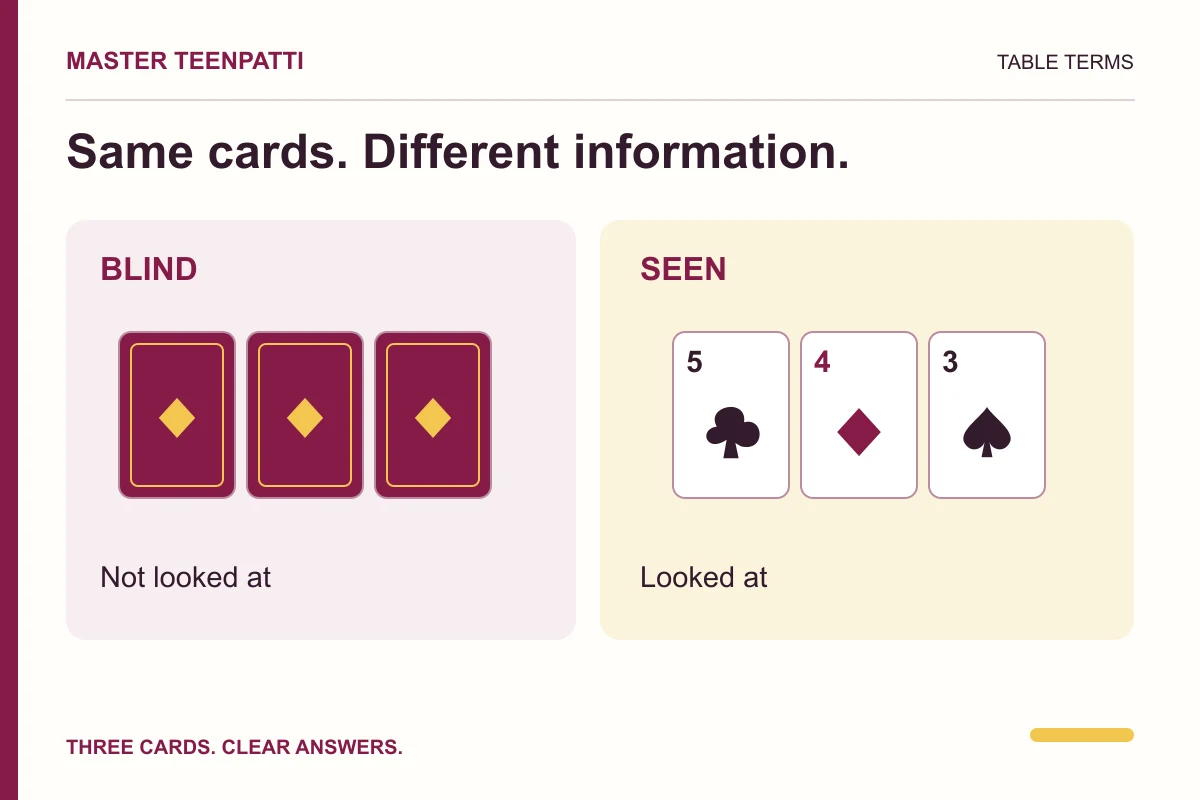
Blind means you have not looked at your cards; seen means you have. Looking changes the information you hold and may change the amount required on your turn. It does not change your three cards or improve their ranking.
Blind and seen describe the player, not the hand
Picture three face-down cards in front of you. Before you look, you are blind. After you look, you are seen—even if nobody else has seen them. A player can hold a trail, a pair or a high-card hand in either state.
That distinction helps with two common misunderstandings: blind does not mean a low-value hand, and seen does not mean showing your cards to the table. Revealing cards for a comparison is a separate action, explained in show versus sideshow.
A worked example using chips
For illustration, take a table using Octro’s published classic stake model: blind bets are one or two times the current stake; seen bets are two or four times it. This is a model to practise reading, not a verified limit in the linked APK.
| Player state | Example permitted amounts | What the amount means |
|---|---|---|
| Blind | 10 or 20 chips | 1× or 2× the current stake |
| Seen | 20 or 40 chips | 2× or 4× the current stake |
| Pot | A separate total | Chips already contributed by everyone |
- Suppose a seen player puts in 20. In this model, the next stake is 10: half the seen bet.
- If the next player is blind, 10 or 20 is available under the example rules.
- If that player puts in 20 blind, the stake becomes 20. A following seen player then faces 40 or 80—not the earlier 20 or 40.
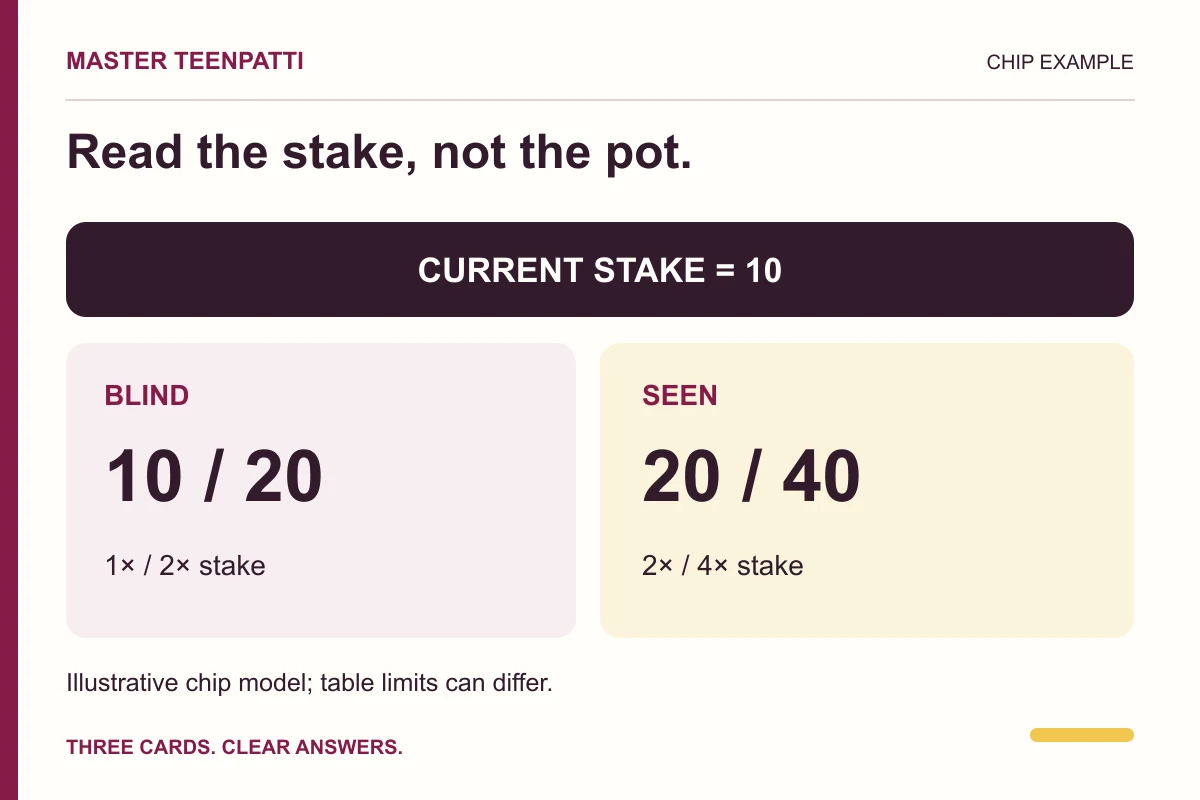
Keep boot, stake and pot separate
Boot is the opening contribution. Current stake is the reference amount for the next action. Pot is the running total collected in the middle. They can all show different numbers during the same hand. A large pot does not, by itself, tell you the next permitted chaal.
Before pressing a button, read its displayed amount and the current table limit. If the number differs from an example on this page, use the table’s rule panel to identify why. Never treat a sample arithmetic table as an instruction to increase a stake.
What to check after you look
Treat looking as a change in information, not a reset of the hand. Check the mode’s instructions before assuming you can return to blind. If an amount exceeds a limit you set for yourself, a previous contribution is no reason to continue. Our limits and responsible-play page covers stopping decisions.
- Your status: has the interface changed from blind to seen?
- The next action: what amount is actually displayed, and is packing available?
- The limits: is there a cap on blind turns, the pot or the next chaal?
- The comparison rules: does your status allow show or sideshow at this point?
Questions readers ask
Does seen mean everyone can see my cards?
No. Seen means you have looked at your own cards. It is different from a show or another comparison procedure.
Is blind always cheaper?
Not in every comparison. In the example, a blind raise of 20 and a seen minimum of 20 cost the same at a stake of 10. Compare the actual available amounts.
Does blind play increase the chance of a better hand?
Looking does not replace the cards already dealt. Blind and seen describe information and table actions, not a method for improving the cards.
Sources & scope
The numerical walkthrough is an original illustration of the cited classic stake model. Apps and table modes can use different limits. This is a rules explanation, not a staking recommendation or evidence that Master TeenPatti offers those settings. Sources consulted 15 October 2026.