
The most useful beginner correction is to name the hand category before comparing individual cards. Then check suits, player status and the table’s rules. This guide fixes seven common misunderstandings; it is not a betting system or a promise of wins.

1. Comparing an ace before checking the category
A♥ Q♥ 9♥ looks strong because it contains an ace. But 3♣ 4♦ 5♠ wins against it under classic Teen Patti rankings: a sequence beats a colour. Starting with “my highest card is bigger” skips the category comparison.
Use two questions in order: what category is each hand, and—only if those categories match—which ranks decide it? Read the six-category chart from strongest to weakest before practising individual match-ups.
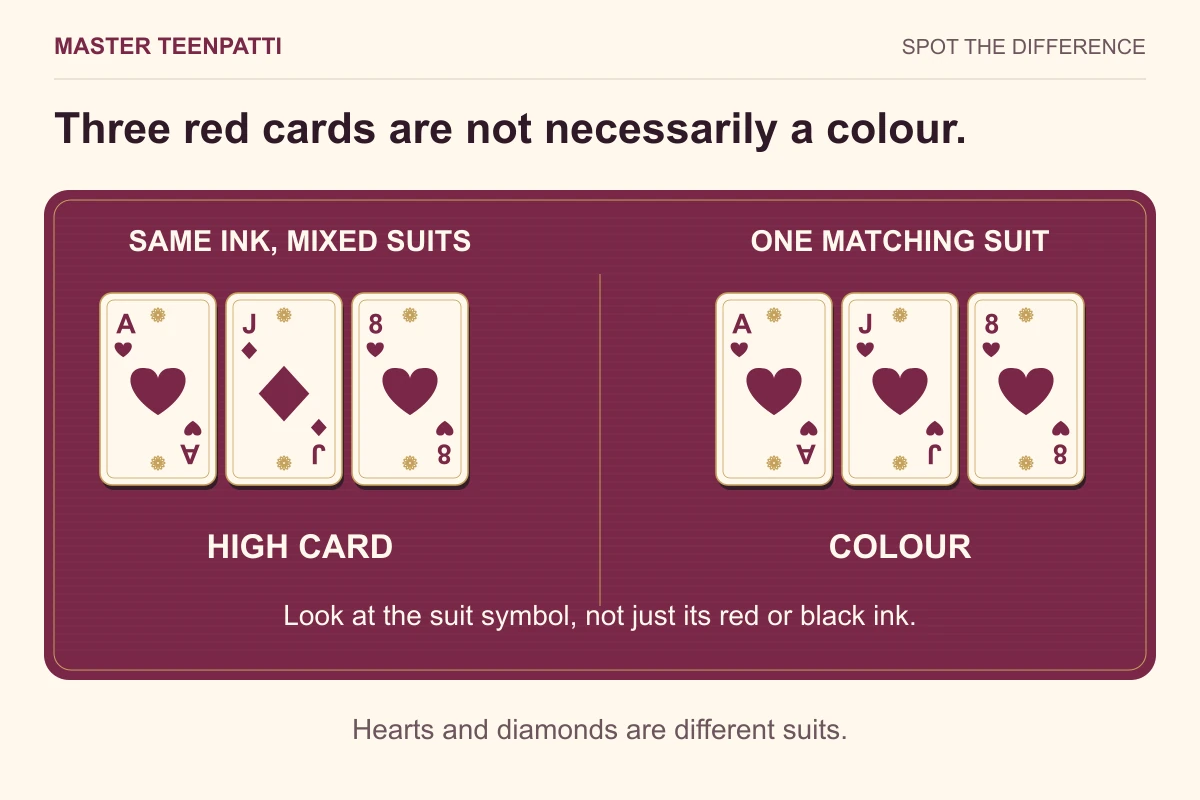
2. Treating three red cards as a colour
“Colour” is a game term for three cards of one suit, not simply three red or three black cards. A♥ J♦ 8♥ mixes hearts and diamonds, so it is not a colour. A♥ J♥ 8♥ is a colour because all three suits match.
The same check separates a sequence from a pure sequence. 4♥ 5♦ 6♥ has consecutive ranks but mixed suits; 4♥ 5♥ 6♥ also shares a suit. The sequence and colour guide provides side-by-side examples.
Swipe sideways to see all columns →
| Cards | Correct category | Reason |
|---|---|---|
| A♥ J♦ 8♥ | High card | Mixed suits; no consecutive ranks |
| A♥ J♥ 8♥ | Colour | One suit; no consecutive ranks |
| 4♥ 5♥ 6♥ | Pure sequence | One suit and consecutive ranks |
3. Calling yourself blind after looking
Blind and seen describe whether you have looked at your cards. They do not describe whether you feel confident. Once you look, use the seen rules for that hand; deciding to ignore the cards does not make you blind again.
In a practice session, announce the change as soon as you look. That makes the applicable action and stake rules easier to follow. In an app, read its displayed status and controls rather than assuming the labels work like another game you have played.
4. Confusing the current stake with the whole pot
The pot is the accumulated total. The current stake is the reference amount used by the selected betting rule. A pot of 100 does not by itself tell you the next permitted action amount. You also need the current stake, blind or seen status, and table limits.
For example, in the illustrative model used in our blind and seen explanation, a stake of 10 gives blind options of 10 or 20 and seen options of 20 or 40. These are rule examples, not instructions to place a cash bet and not verified APK limits.
5. Asking for a show while three hands are active
A final show and a sideshow serve different purposes. In the classic rules described by our sources, show is the comparison with two active hands remaining. A sideshow may compare two eligible hands while other players remain, subject to the table’s request and acceptance rules.
If A, B and C are active and a valid sideshow eliminates A, B and C still remain. The sideshow has not automatically settled the entire round. Move packed hands aside while practising; then use the show versus sideshow guide to follow the active-player count.
6. Carrying one table’s rules into every variation
An ace-run order, joker selection or equal-hand procedure can differ between published rule sets. Do not silently settle an A–2–3 dispute from memory if your table has specified another order. Agree the relevant rule before the deal, not after seeing which result benefits your hand.
Similarly, A, K, 4 and 7 are not automatically wild in classic Teen Patti. They have that role in the AK47 variation discussed in our Joker and AK47 guide. Keep variation names attached to their rules.
7. Using a win as proof of a good decision
A correct explanation can accompany a losing hand, and a misunderstanding can accompany a win. Record the rule you applied rather than judging the lesson only by the outcome. Predicting that a win is “due” after losses does not improve the next deal.
Use no-cash offline practice to check what you learned. Stop at the time you planned. If play starts interfering with money, time or daily responsibilities, step away and read the limits and support page.
- Name the category before the highest card.
- Check the actual suit symbols and whether you have looked.
- Confirm active players, the selected variant and the rule for ties.
- Explain the decision in one sentence, regardless of the outcome.
Questions readers ask
Is an ace-high colour stronger than a low sequence?
No, under classic rankings a sequence beats a colour. Compare categories before the rank of the highest card.
Can three red cards make a colour?
Only if all three have the same suit. Mixing hearts and diamonds does not make a colour, even though both suits are red.
Will avoiding these mistakes guarantee a win?
No. These corrections improve rule understanding. Cards and other players’ decisions remain uncertain; the guide offers no winning guarantee.
Master TeenPatti · Practical guides
Check the mistake you are actually making
If you choose the ace-high colour over a low sequence, practise category order. If you add three card values, use the high-card exercise. If you choose a suit to break equal ranks, read the tied-hand explanation. Each needs a different correction.
Find your practice example →Sources & scope
The rule corrections use the cited classic rules and variant definitions. Worked deals and the self-check are original teaching examples, not personal gameplay results or tested APK behaviour.