
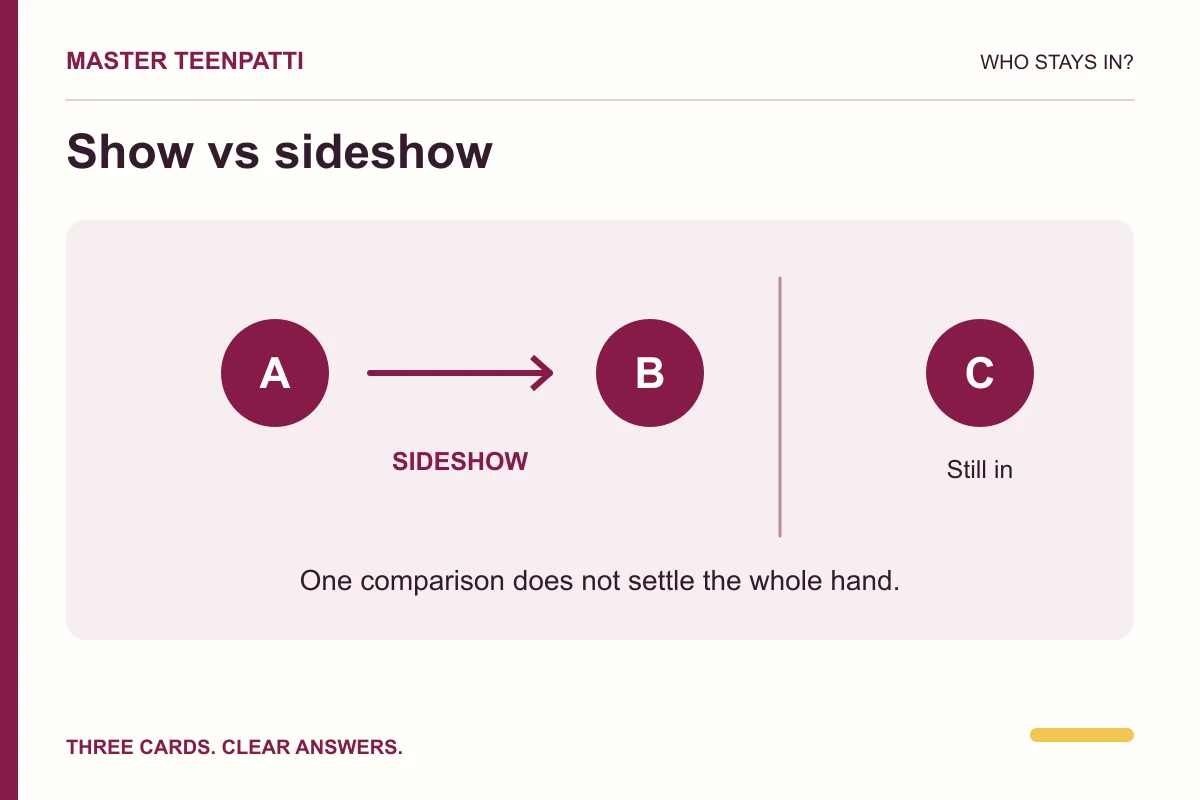
A show normally settles a hand between the final two players. A sideshow is a private comparison between eligible seen players while others remain. Winning a sideshow does not automatically win the pot.
The difference is what the comparison decides
Think of a sideshow as resolving one comparison inside an unfinished hand. A show resolves the final comparison. The similar names make them easy to mix up, particularly when an app uses shortened button labels.
| Question | Show | Sideshow |
|---|---|---|
| What is being decided? | The final two players’ hand | Which of two eligible players stays |
| Does the hand end? | Normally, yes | Other players may still remain |
| Can a request be declined? | Check show eligibility and cost | A sideshow recipient may decline |
| What must be checked? | Blind/seen status and tie rule | Eligible opponent, consent and tie rule |
A three-player sideshow example
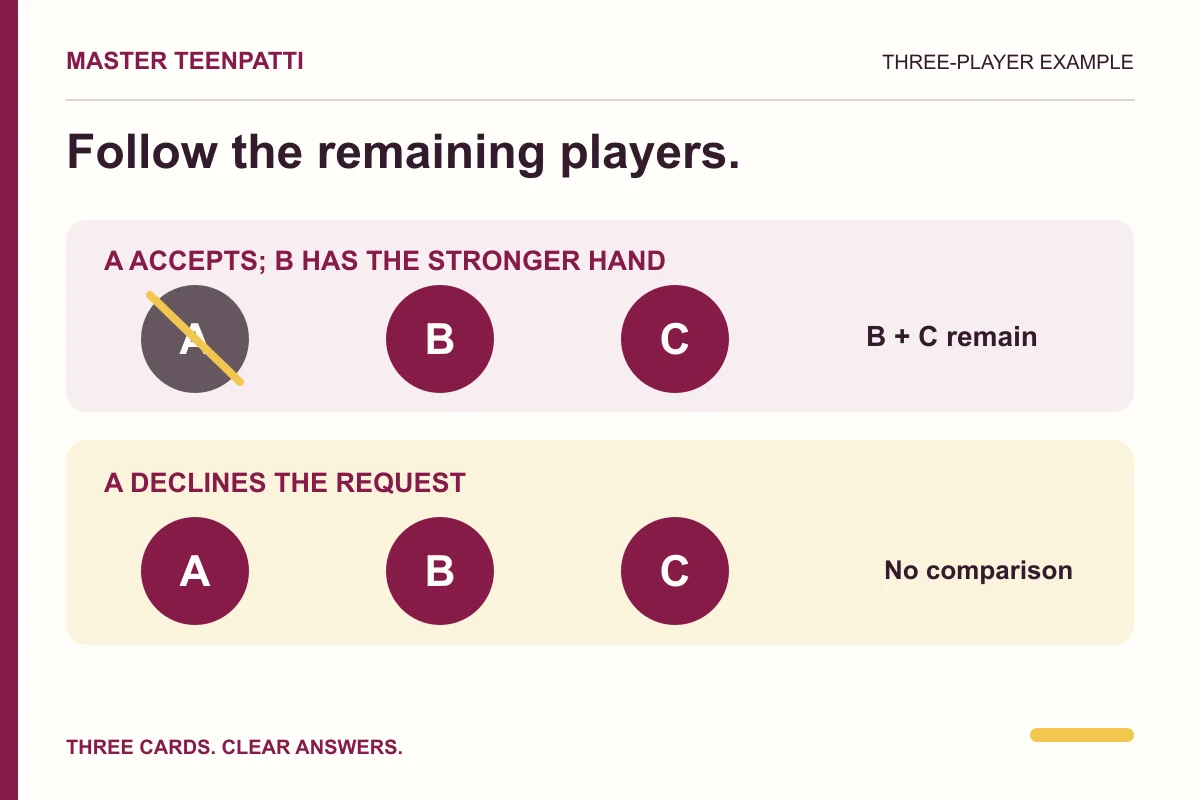
Consider A, B and C, all still active. A and B have looked at their cards. Suppose the turn order and table rules allow B to request a sideshow from A. If A accepts and B has the stronger hand, A leaves; B and C remain. B has not yet beaten C.
If A declines, the request alone does not establish which hand is stronger. Both stay in the hand under the cited classic format. Do not treat a declined request as a reveal, a fold or proof of a weak hand.
If A has the stronger cards after accepting, B leaves instead. Use the sequence-versus-colour examples to practise a category comparison before adding the turn rules.
When only two players remain
Now imagine only B and C remain. The question has changed: an allowed show will settle their hands rather than remove one player from a larger group. Whether B may request it—and at what cost—depends on the table’s rules and the players’ blind or seen status.
Count active players, not occupied seats. A person who has packed is no longer a contender in that hand. Likewise, seeing your own cards does not mean you have requested a show. See blind and seen explained if those status labels are unfamiliar.
Agree on ties before a comparison
An equal-ranked hand needs a tie procedure. For example, TeenPatti Royale’s published showdown rule makes the requester lose a tied showdown. That is a specific published rule, not permission to apply it to every app or to every sideshow.
Before a home game, record the tie rule alongside the ace order. In an app, look for it in the mode’s help panel. If the panel does not explain it, ask the operator rather than assuming the pot is split. The outcome should follow a rule agreed before the cards are revealed.
Before pressing Show or Sideshow
The table glossary provides short definitions of pack, chaal and boot. Keep those actions separate from a request to compare cards.
- Count how many players are still in the hand.
- Check your status and the selected opponent’s status.
- Read the request cost and whether the other player can refuse.
- Check what happens to the losing player and to an exactly tied hand.
- If the button is unavailable, read the eligibility conditions instead of tapping a different action to experiment.
Questions readers ask
Does winning a sideshow mean I win the pot?
No. In the example above, another player remains. Winning that comparison only keeps you in the hand.
Does a refused sideshow expose either hand?
Under the cited classic procedure, no comparison takes place when the request is refused. It does not reveal the strength of either hand.
Why is my sideshow button disabled?
Possible rule conditions include player status, turn order and the number of remaining players. Consult that mode’s rules; this guide cannot diagnose the linked APK’s interface.
Sources & scope
These are general rule explanations with an original A/B/C walkthrough. The cited developers document their own games; their conditions are not verified features of the APK linked on this site. Sources consulted 15 October 2026.