18+. Play responsibly. Check the app’s age and local requirements.

Master TeenPatti · The three-card game

How to Play Teen Patti: Rules & Hand Rankings

Each player receives three cards. A hand ends when everyone else packs or an eligible show settles the remaining hands. Learn the six ranks first, then the order of play.

Classic three-card rules. Check the selected table for variants and ties.

Three aces and plain counters on a plum Teen Patti table — brand illustration.

Master TeenPatti

Master TeenPatti

Master TeenPatti · Practical guides

Try the cards before the table

Choose the stronger hand, then see which single detail decides it. Six worked comparisons; no account, chips or timer.

Classic categories, no jokers. These exercises avoid A–2–3 ordering because tables differ. Equal ranks are reported as equal; pot settlement is not simulated.

Comparison 1 / 6

A small sequence or an ace-high colour?

Hand A

Hand B

A wins. 4–5–6 is a sequence; A–J–8 of hearts is a colour. Compare the category before the highest card. The ace does not move a colour above a sequence.

Change one card. Change only 5♥ to 9♥: A becomes 9–6–4 high card, so B’s colour wins.

Comparison 2 / 6

Three twos against three royal cards

Hand A

Hand B

B wins. Three twos make a trail. A–K–Q of spades is a pure sequence. Any trail ranks above any pure sequence, even when its individual cards are lower.

Change one card. Change only 2♥ to 3♥: B becomes a pair of twos, so A’s pure sequence wins.

Comparison 3 / 6

The pair matches. What breaks the tie?

Hand A

Hand B

A wins. Both hands have a pair of eights, so compare the spare card: king beats queen. The suit of the pair is not the deciding detail.

Change one card. Change only K♣ to J♣: the pairs still match, but B’s queen now beats A’s jack.

Comparison 4 / 6

Both colours start with ace and jack

Hand A

Hand B

B wins. Both hands are colours. Ace matches ace and jack matches jack; the third comparison is nine against seven. Nine decides it.

Change one card. Change only 7♠ to 10♠: A’s ace and jack still match B’s, but ten now beats nine.

Comparison 5 / 6

Do not add the three card values

Hand A

Hand B

A wins. These are high-card hands. The aces match, then ten beats nine. Adding all three card values would answer the wrong question; the third card is not reached here.

Change one card. Change only 10♥ to 7♥: B now wins on the second card, nine against seven.

Comparison 6 / 6

Different suits, identical ranks

Hand A

Hand B

The hand ranks tie: K–J–8 against K–J–8, both mixed suits. This exercise gives suits no extra rank. Settling a tied show or sideshow is a separate table rule; equal hand rank does not automatically mean splitting a pot.

Change one card. Change only 8♦ to 9♦: B wins on the third card. The king and jack still match.

Examples prepared for Master TeenPatti. Category order checked against Octro’s classic rules; tie comparisons follow Pagat.

After learning the rankings, use offline card practice to test the rule. The hand-frequency table explains rarity; the Rummy comparison explains why familiar combinations have different jobs in another game. For equal-looking hands, compare the ranks in the tie-breaker worksheet.

Read a hand before choosing an action

Use three separate questions: what cards do I hold, have I looked at them, and what action is available? A hand category, a player status and a table action describe different things.

For example, 7♣ 8♦ 9♠ is a mixed-suit sequence. Looking at those cards makes the player seen; it does not change the sequence. A Show button, if available, concerns a comparison under the table rules—not the name of the hand.

Learn these distinctions in order: sequence versus colour, blind versus seen, then show versus sideshow. The examples explain general rules, not verified controls in the linked APK.

The game at a glance

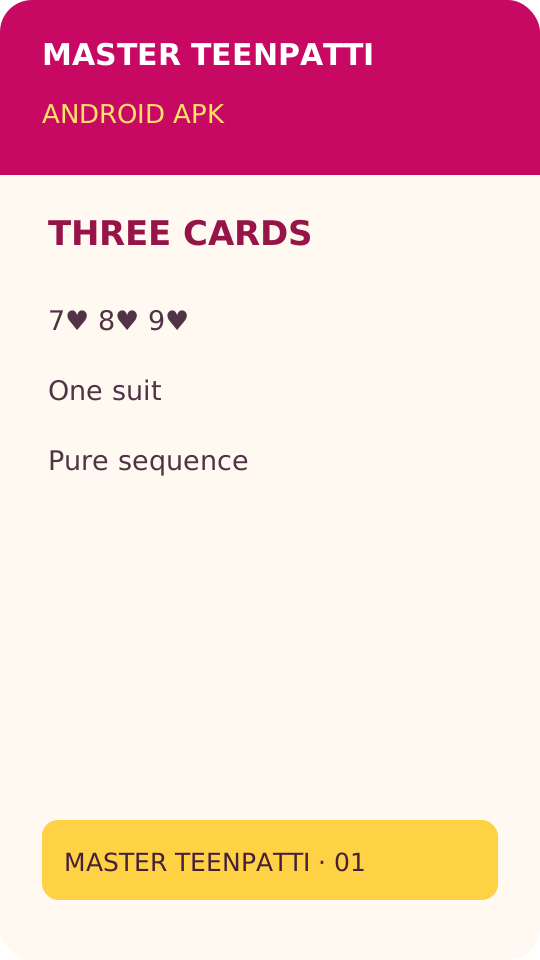
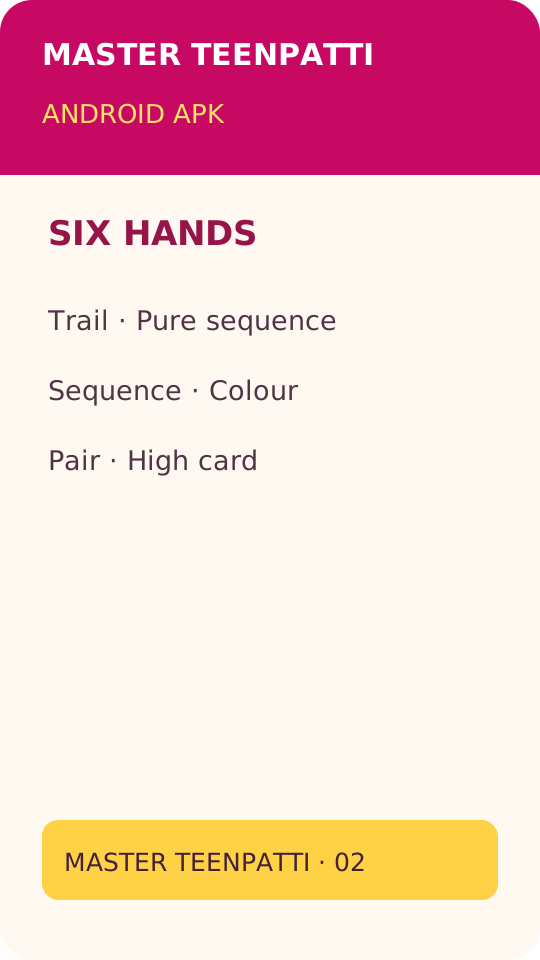
7♥, 8♥ and 9♥ form a pure sequence: consecutive cards of the same suitTeen Patti hand rankings, highest to lowest: trail, pure sequence, sequence, colour, pair, high cardTeen Patti table terms: boot, chaal, blind, seen, pack and show

How a round works

  1. Each player receives three cards. The boot is the starting contribution to the pot.
  2. Blind means you have not looked at the cards; seen means you have. Check the permitted stake for each.
  3. Chaal keeps you in the hand. Pack means leaving that hand.
  4. A show compares eligible hands. The table rules specify who can request it and when.
  5. If everyone else packs, the remaining player takes the pot.

Hand rankings: highest to lowest

HandDescription
Trail / trioThree cards with the same rank. A♠ A♥ A♦
Pure sequenceThree consecutive cards, all in one suit. 7♥ 8♥ 9♥
Sequence / runThree consecutive ranks with mixed suits. 4♠ 5♥ 6♦
Colour / flushThree cards in one suit, without a sequence. 2♣ 7♣ J♣
PairTwo cards with the same rank. Q♠ Q♥ 4♦
High cardA hand outside the categories above. 2♠ 6♥ J♦

Rules that vary by table

Classic

The standard six-hand order is a starting point. Confirm the table’s rules for aces and ties.

Muflis

Muflis commonly reverses the hand order. Read the exact ranking instead of assuming classic rules apply.

Joker

Wild cards change how a hand is formed. Check which cards count as jokers and how they are assigned.

AK47

This name commonly refers to aces, kings, fours and sevens acting as wild cards. Availability in the APK is not confirmed.

Table-specific limits

Boot, chaal, pot limits, timers and show conditions belong to the selected table. This guide does not promise any particular app variant.

Before you take a seat

  • Read the full hand order before the first round.
  • Check the action amount before confirming a chaal.
  • Check when a show is permitted and how a tie is resolved.
  • Choose a stopping time in advance and take breaks.

Tables, stakes and timers

Check the boot amount, permitted raise, pot limit and turn timer before joining. The starting boot does not tell you the maximum a hand can cost. Specific limits, private tables and practice modes have not been verified for the linked APK.

When two hands have the same category

Compare the ranks within the category. For two pair-category hands, compare the paired rank first, then the spare card if the pairs match. For two colours or high-card hands, compare the highest card, then the next if needed. Exact ties and ace-containing runs follow the agreed table rule.

Common mistakes

  • Mixing up a pure sequence and a sequence: only the pure sequence requires one suit.
  • Treating three cards of one suit as a sequence when their ranks are not consecutive.
  • Assuming blind and seen players can take exactly the same actions.
  • Reading a previous hand as a guarantee about the next one.

Common table terms

Boot
The starting contribution before cards are dealt.
Chaal
A contribution on your turn to stay in the hand.
Blind / seen
Playing without viewing your cards / playing after viewing them.
Pack / fold
Leaving the current round.
Show
Comparing eligible remaining hands under the table’s rules.

Teen Patti rules: common questions

What is the highest hand in standard Teen Patti?

Trail—three cards of one rank—is the highest category. Three aces are the highest trail in the standard high-hand order.

Does a sequence beat a colour?

Yes, in standard rankings. A mixed-suit sequence beats a same-suit colour even when the colour has higher individual cards.

Is A-2-3 always higher than A-K-Q?

No single ordering applies to every table. Check the ace rule for the selected mode before comparing these runs; published rule sets differ.

Can a player win without showing the cards?

Under the common procedure, if every other player packs, the last active player takes the pot. This is different from winning a show by comparing hands.

Practise a comparison before a round

Compare Q♣ Q♦ 3♥ with J♠ J♥ A♦. Both are pairs; the queens win before the spare ace matters. Now compare Q♣ Q♦ 3♥ with Q♠ Q♥ 8♦: the pairs match, so the spare eight wins.

Compare A♣ J♣ 8♣ with A♦ J♦ 5♦. Both are colours; the ace and jack match, so the third card decides. Suit names alone do not settle the result.

Practise without money: identify the category, compare ranks within it, then check for a tie. A comparison win may not end the round: see show versus sideshow.

Rule references: Octro: Learn Teen Patti · Pagat: Teen Patti. These describe published rule sets; the selected table determines variants and ties.


Check your reasoning, not just the winner

Compare 4♥ 5♣ 6♦ with A♠ J♠ 8♠. First name the categories. The first hand is a sequence; the second is a colour. Under classic rankings the sequence is higher, even though the colour contains an ace.

Now compare 9♣ 9♦ 4♥ with 9♥ 9♠ K♣. Both are a pair of nines, so compare the remaining card: king beats four. This is a tie-break within a category, not a new hand category.

Work through more tie-breaks · Practise with one deck