
Classic Teen Patti compares each player’s three cards. Texas Hold’em deals two private cards and uses five shared board cards to form the best five-card hand. The familiar words can be misleading: a Teen Patti sequence beats colour, while a five-card poker flush beats a straight.
First, name the poker format
“Poker” covers several games. This page compares classic, no-joker Teen Patti with standard high-hand Texas Hold’em. It does not apply every rule below to Omaha, stud, short-deck poker or a casino’s three-card game. That distinction matters before you compare even the number of cards.
The useful question is not whether Teen Patti is sometimes called Indian poker. It is what cards a player may use and how the resulting hand is ranked. Keeping those two questions separate makes the differences easier to see than a general claim that one game needs more skill or takes longer.
Private cards versus a shared board
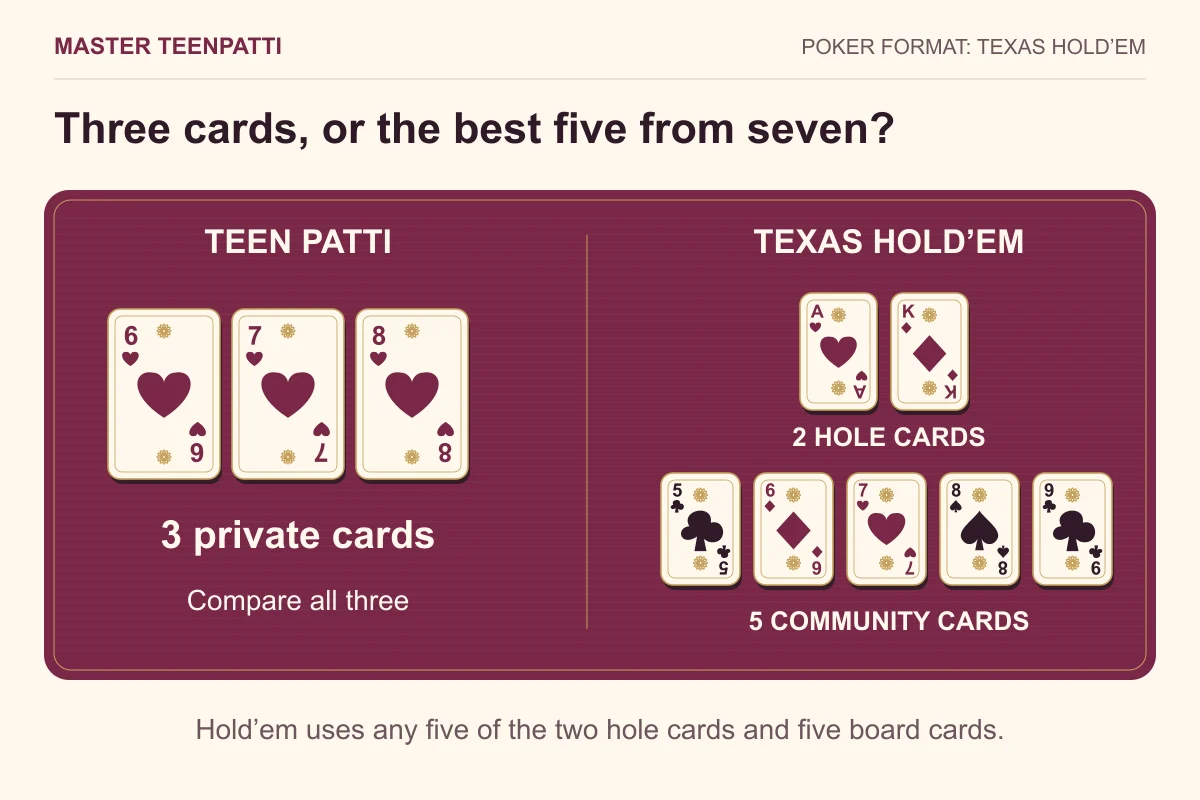
In classic Teen Patti, three private cards constitute the hand being compared. In Hold’em, two private cards are only part of the available information. The shared board appears in stages: three cards on the flop, one on the turn and one on the river. At the end, choose the best five cards available to you; you may use both, one or neither of your private cards.
Swipe sideways to see all columns →
| Feature | Classic Teen Patti | Texas Hold’em |
|---|---|---|
| Private cards | 3 | 2 |
| Shared board in this format | None | Up to 5 community cards |
| Final ranked hand | 3 cards | Best 5 of the available 7 |
| Must use both private cards? | All three cards form the hand | No; use zero, one or two |
| Three cards of one suit | Colour if not consecutive | Not enough for a five-card flush |
The ranking trap: sequence and colour
Consider 4♣ 5♦ 6♥ against A♠ J♠ 8♠ in Teen Patti. The first hand is a sequence and the second is a colour. Under the classic hierarchy, the sequence wins even though its individual ranks are lower. There are only three cards in each hand; both are complete combinations for that game.
Now consider two five-card poker hands: 4♣ 5♦ 6♥ 7♠ 8♦ and A♠ J♠ 8♠ 5♠ 2♠. The first is a straight and the second a flush. In standard high-hand Hold’em rankings, the flush wins. Importing the Teen Patti category order would reverse the correct result. The names “colour” and “flush” describe same-suit patterns, but the card count and ranking hierarchy belong to the chosen game.
You also cannot make two pair, a full house or four of a kind with only three cards. Those five-card poker categories are not missing entries in the Teen Patti ranking chart; they require more cards than a classic hand contains.
A worked Hold’em hand: use just one private card
Lay out a board of J♣ 10♦ 9♥ 8♠ 2♣. Give player A Q♦ 3♥ and player B A♥ A♦. A can select 8♠ 9♥ 10♦ J♣ Q♦ for a queen-high straight. The 3♥ does not belong in the best five. B has a pair of aces with other cards from the board, but that pair loses to the straight.
The point of this example is selection, not a recommended play. Two private cards do not have to stay together in the final five-card hand. To check the answer on paper, physically move the chosen five cards into one row and leave the unused cards outside it. Then classify that row. Looking only at A’s queen and B’s two aces misses the shared cards.
When both players use the same five cards
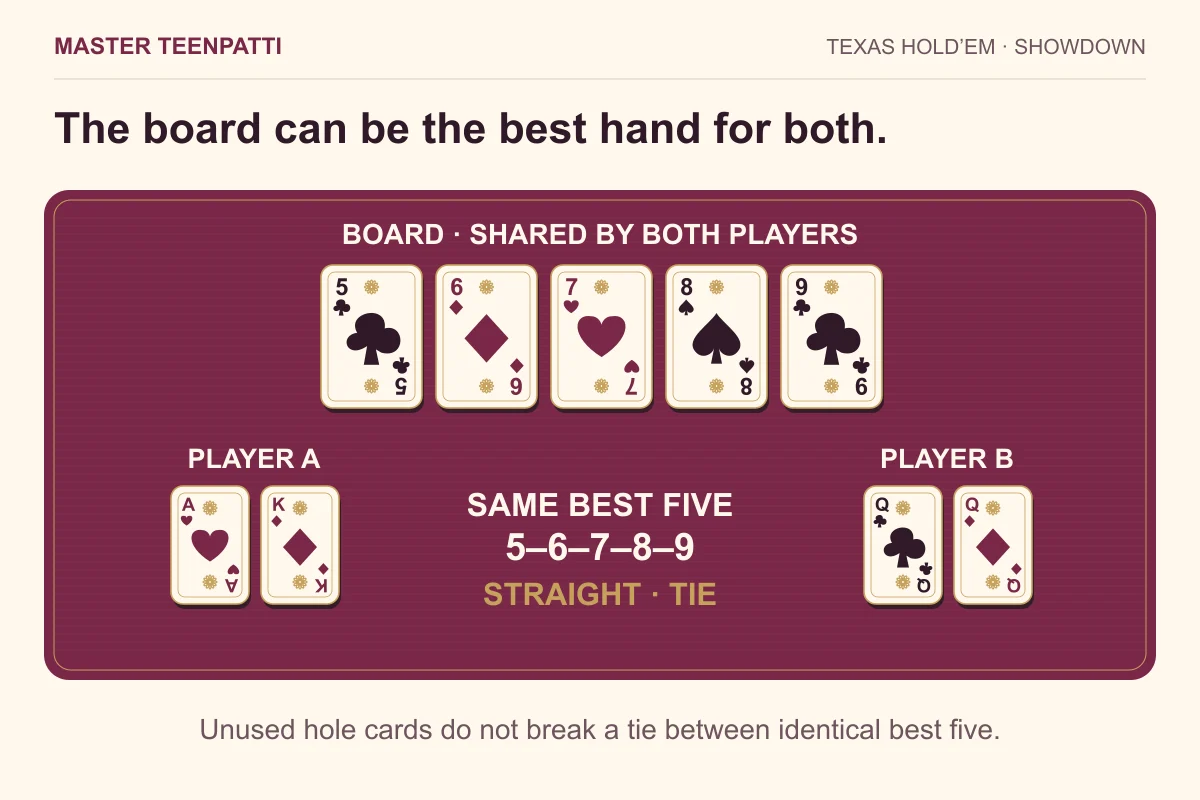
Change the board to 5♣ 6♦ 7♥ 8♠ 9♣. Give A A♥ K♦ and B Q♣ Q♦. Both players’ best five-card hand is the nine-high straight already on the board. Neither the ace nor the pair of queens improves that straight. Under standard Hold’em rules they have equal best hands.
It is tempting to use the ace as an extra tiebreaker. But that would compare a sixth card. Once both best five-card hands are identical, an unused private card cannot make one of them higher. The illustration below the comparison table shows this exact board so you can check all nine physical cards.
Do not automatically import that settlement procedure into Teen Patti. Exact ties at a requested show or sideshow can use a different table rule. The show and sideshow guide separates equal hand ranks from the procedure used to resolve a comparison.
“Blind” does not mean the same thing
In Teen Patti, a player described as blind has not looked at their own cards. Looking changes the player’s information status. In Hold’em, small blind and big blind name forced contributions and their positions; posting one does not mean the player must keep their hole cards unseen.
That is why a friend saying “I am the big blind” is not describing the Teen Patti blind-versus-seen choice. Keep the vocabulary attached to its game. Our blind and seen explanation uses illustrative counters for the Teen Patti rule; those amounts are not a Hold’em betting schedule.
A short exercise to catch transferred rules
Use a deck without stakes. First lay out two complete three-card Teen Patti hands and compare them. Next lay out the shared-board example, add the two private hands and ask each person to point to exactly five cards. Do not name a winner until each chosen five-card set is visible.
Write down the reason for each answer: category order, card selection or a tie. A wrong answer becomes useful when you know which rule was borrowed from the other game. For more three-card examples, try offline practice. To compare a third format, read Teen Patti versus 13-card Rummy, where arranging groups replaces the task of selecting a best poker hand.
Questions readers ask
Is Teen Patti the same as Texas Hold’em?
No. Classic Teen Patti compares three private cards; Hold’em selects a best five-card hand using two private cards and five shared cards. Their category hierarchies also differ.
Do I have to use both hole cards in Hold’em?
No. Standard Hold’em permits zero, one or two hole cards in the best five-card hand. This rule should not be transferred to other poker formats without checking them.
Does three of one suit make a poker flush?
Not a five-card Hold’em flush. It takes five cards of one suit. In classic Teen Patti, three same-suit, nonconsecutive cards are a complete colour hand.
Sources & scope
Classic Teen Patti definitions are referenced to Octro. Texas Hold’em card selection, stages and ranking follow PokerStars’ rules reference. The card layouts and comparison exercises are original and do not imply that either format is available in the linked APK.