
Boot starts the pot. Chaal keeps a player in the hand. Pack leaves that hand. Blind and seen describe whether a player has looked at their cards; show and sideshow are ways to compare eligible hands.

Teen Patti terms at a glance
Swipe sideways to see all columns →
| Term | Meaning | Do not confuse it with |
|---|---|---|
| Boot / ante | The agreed starting contribution before the deal | The maximum cost of the hand |
| Pot | All contributions collected for this hand | The amount due on your next turn |
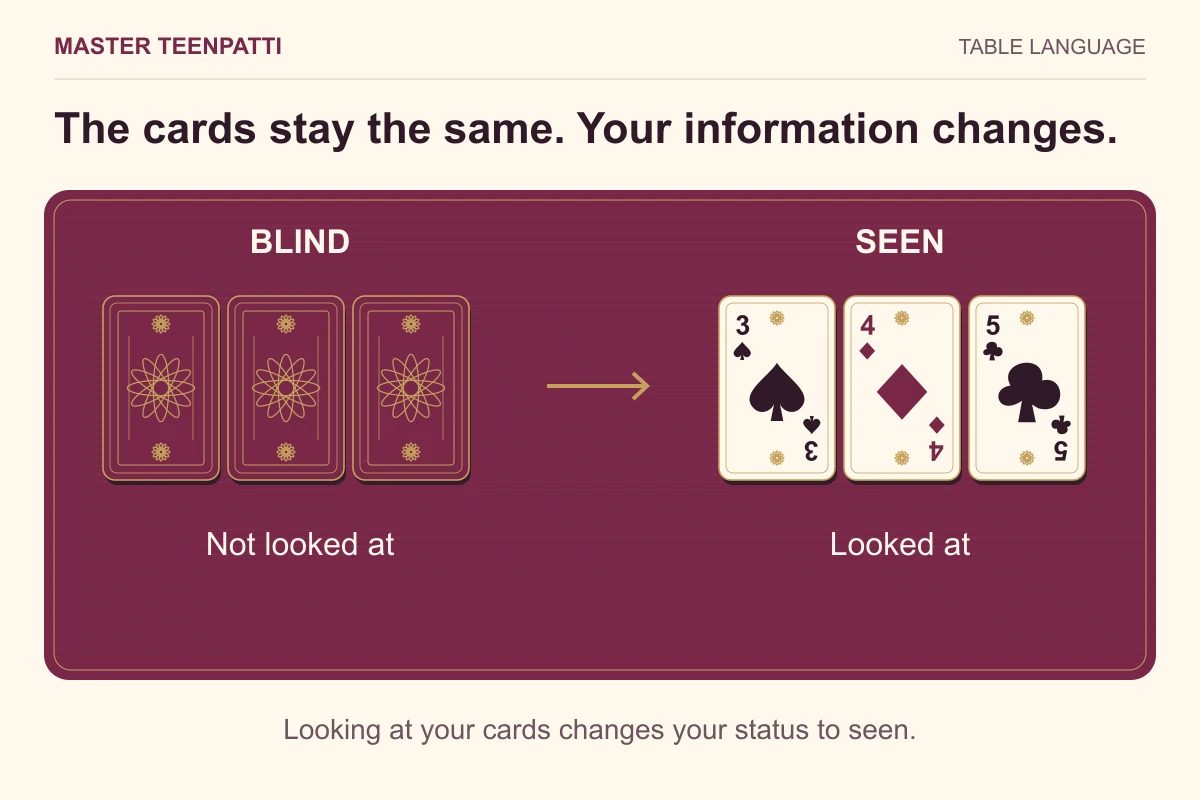
| Blind | Playing before looking at your own cards | Cards hidden from other players |
| Seen | You have looked at your own cards | Showing those cards to the table |
| Chaal | A contribution made on your turn to remain in the hand | Your total contribution across the whole hand |
| Pack / fold | Leave this hand and stop competing for its pot | Closing the app or deleting your account |
| Show | An eligible final comparison of the remaining hands | Simply looking at your own cards |
| Sideshow / side show | A private comparison between eligible seen players | Automatically winning the whole pot |
Boot, pot and chaal in one example
Four players each put in a boot of 5 counters. Before any later action, the pot contains 20 counters. If one player then adds 10 counters as their chaal, the pot becomes 30. The boot is still 5; the latest contribution was 10; the accumulated pot is 30.
These numbers illustrate the vocabulary, not a permitted stake schedule. The selected table decides which contribution is allowed. Read the displayed action amount instead of treating the pot total as the amount you must add.
How to read “Seen · Chaal 20”
Seen describes the player’s status. Chaal describes the action, and 20 is its displayed amount. The label says nothing about the strength of the three cards. A seen player can hold a high card, a pair or any other hand category.
Once you can name a hand, compare a sequence with a colour. To understand how frequently each category appears, follow the 22,100-hand calculation; a category’s frequency is a different question from its rank.
Looking at your cards privately still makes you seen. For the effect on the next contribution, see the blind and seen example.
Pack, show and sideshow have different outcomes
Packing ends your participation in this hand. A show can settle the final comparison. A sideshow can remove one player while others remain, and a request may be declined under the applicable rules.
For example, if A and B compare while C is still in the hand, the winner of that comparison has not yet beaten C. Follow the three-player walkthrough before treating “comparison won” as “pot won”.
Same word, different job
“Call”, “chaal” and “stake” may appear close together, but a label does not tell you the table’s whole action rule. Read the displayed amount and the selected mode’s explanation together.
Use this sentence to separate the parts: “A is seen, holds a pair and chooses to pack.” Seen is a status, pair is a hand category and pack is an action. Packing does not change the cards into a weaker category; it ends A’s participation.
Hand names describe the cards, not the action
Trail, pure sequence, sequence, colour, pair and high card are hand categories. Boot, chaal and show are not. Start with the six-hand ranking chart if you need to identify three cards.
Colour means one suit, not three red or three black cards. A♥ 8♦ 3♥ contains two suits and is not a colour. The sequence versus colour guide shows the distinction with comparisons.
Questions readers ask
Is chaal the same as the pot?
No. Chaal is an action contribution; the pot is the accumulated total for the hand.
Does seen mean my opponents can see my cards?
No. It means you have looked at your own cards. Revealing them to other players is a different event.
Does pack mean leaving the app?
No. It means leaving the current hand. The app’s separate exit and account controls are outside this glossary.
Sources & scope
General Teen Patti terminology, with original counter examples. Exact action amounts and eligibility follow the selected table’s rules. This is not a glossary extracted from the linked APK.