
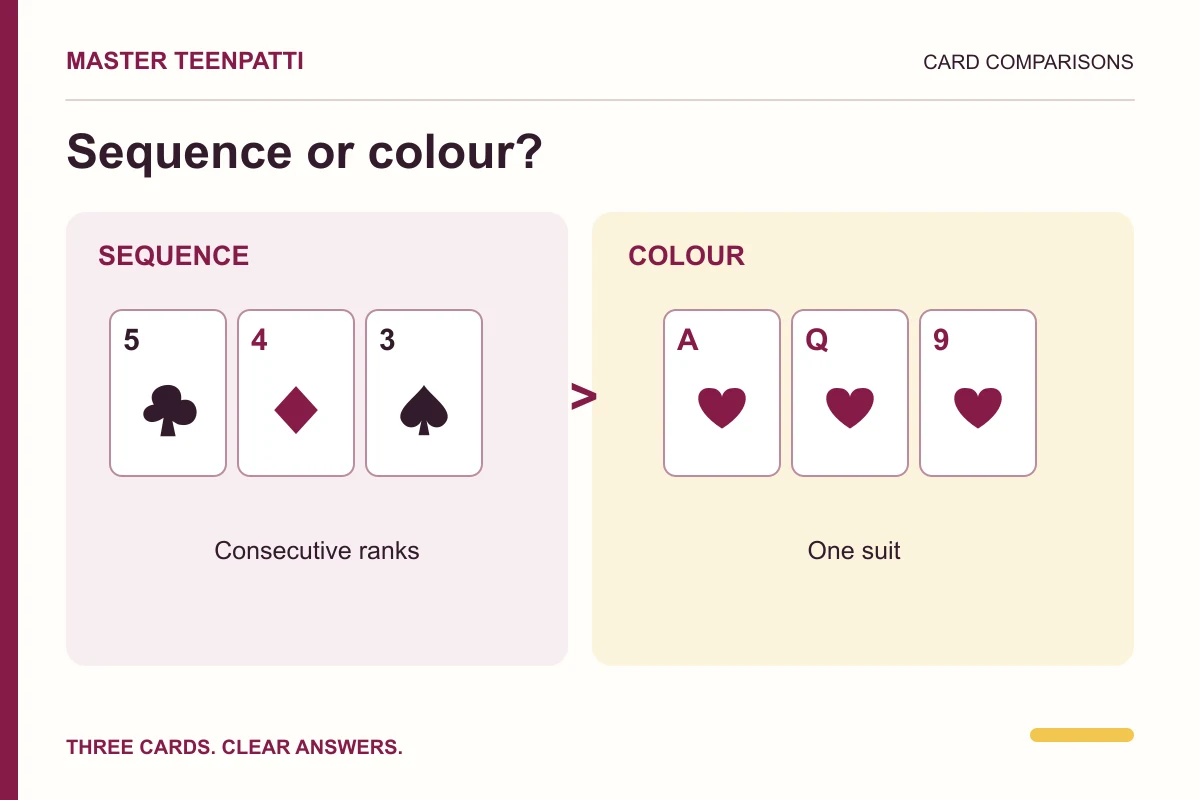
In classic Teen Patti, a sequence beats a colour. A pure sequence beats both. Compare the type of hand first; an ace in a colour does not make it stronger than a lower sequence.
Start with two checks: order and suit
Lay the cards in rank order. First ask whether the three ranks are consecutive. Then ask whether all three suit symbols match. Those two checks separate the hands that are most often confused.
Colour (also written color) means one suit: hearts, diamonds, clubs or spades. Three red cards are not necessarily a colour. Hearts and diamonds share an ink colour, but they are different suits.
| Cards | Hand | What to notice |
|---|---|---|
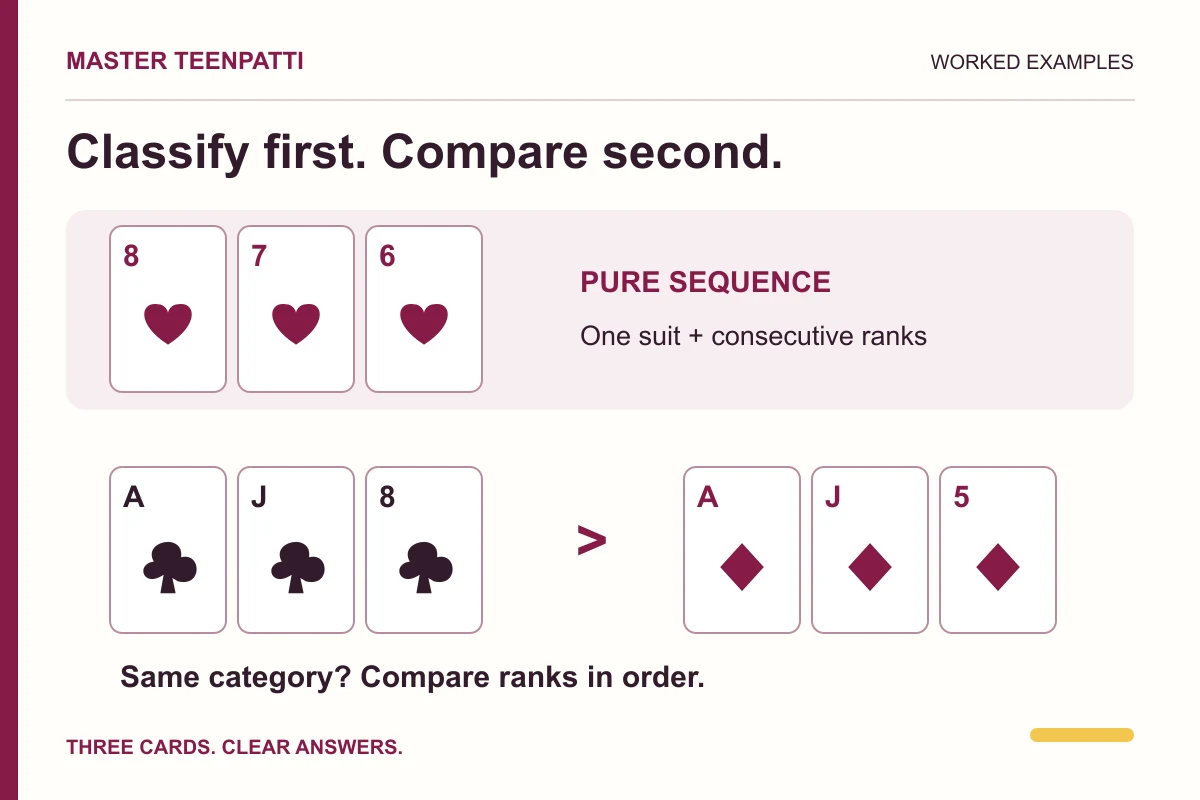
| 8♥ 7♥ 6♥ | Pure sequence | Consecutive ranks; one suit |
| 8♣ 7♦ 6♠ | Sequence | Consecutive ranks; mixed suits |
| A♥ J♥ 6♥ | Colour | One suit; ranks do not form a run |
Why a small sequence beats an ace-high colour
Imagine one player shows 5♣ 4♦ 3♠ and the other shows A♥ Q♥ 9♥. The second hand looks impressive because it has an ace. But the first is a sequence, while the second is a colour. The sequence wins the category comparison; there is no need to compare the aces or the highest cards.
Now change the second hand to 9♥ 8♥ 7♥. It becomes a pure sequence and wins. The important change is the complete hand pattern, not simply the presence of a higher card. See the full hand-ranking guide for where trail, pair and high card fit.
When both hands are colours
Once both hands belong to the same category, compare their ranks. Try A♣ J♣ 8♣ against A♦ J♦ 5♦. The aces match, and so do the jacks. The eight then beats the five. Reading only the top card would miss the result.
If both hands contain the same ranks, stop and consult the table’s tie rule. Do not invent a suit preference because one hand is hearts and the other is spades. A matching rank list needs the agreed tie procedure.
A-K-Q, A-2-3 and table-specific rules
Ace ordering is an important exception to memorising a single chart. Published rule sets differ over where A-2-3 sits. Read the rules for the exact mode before comparing two ace-containing runs; an example from another app is not proof of your table’s order.
This article covers classic rankings. Joker and low-hand variants need their own rules. If a hand contains a wild card, settle what it represents before classifying it. The table glossary explains the surrounding terms without mixing them into the ranking itself.
Three hands to classify before you play
Use a deck and check the symbols slowly. Learning the classification needs no paid table and no prediction about the next deal.
- K♥ 9♦ 4♥: two suits and no run. This is not a colour, even though every card is red.
- J♠ 10♠ 9♠: consecutive ranks in one suit. Classify it as a pure sequence.
- 7♦ 6♣ 5♥: a mixed-suit run. This is a sequence, and it ranks above a non-consecutive same-suit hand.
Questions readers ask
Are colour and flush the same thing?
In this context, flush is another name for the same-suit category. A consecutive same-suit hand is classified more specifically as a pure sequence.
Does an ace-high colour beat a sequence?
No, under classic rankings. The hand category is compared before the highest card.
Is this the verified rule set of the linked APK?
No. These are general Teen Patti examples. Check the rules shown by the operator for the particular mode you enter.
Sources & scope
Card examples and comparisons were prepared for this guide. The references below support the classic categories and show why mode-specific rules matter. They do not verify the linked APK’s gameplay. Sources consulted 15 October 2026.