
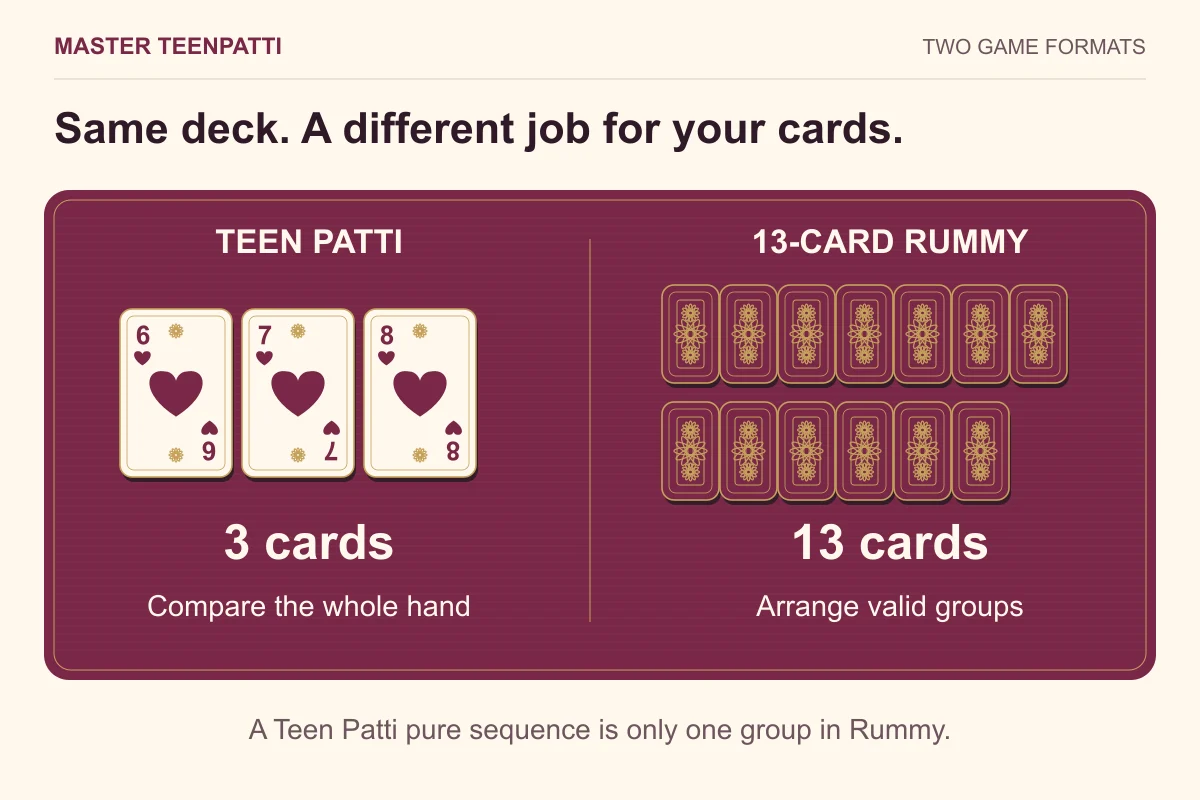
Teen Patti compares a fixed three-card hand against other hands. In 13-card Indian Rummy, you draw and discard while arranging cards into valid sequences and sets. A strong three-card combination in Teen Patti may be only one unfinished part of a Rummy hand.
Start with what ends a hand
The words “sequence” and “set” can make these games sound more alike than they are. In classic Teen Patti, each player receives three cards and keeps those cards for the hand. Eligible hands are compared under a ranking hierarchy. In 13-card Indian Rummy, the task is to organise a larger holding through draws and discards, then meet the declaration requirements of the selected rules.
This comparison uses ordinary Teen Patti without jokers and the common Indian Rummy arrangement requiring at least two sequences, including one pure sequence. Rummy has many variants, deck counts and scoring systems; this is not a guide to every game called Rummy. It also does not establish that the APK linked on this website includes a Rummy mode.
The differences you notice first
A rule that makes sense in one game can produce a wrong decision in the other. Keep this table beside the worked examples: the important difference is the whole-hand objective, not which vocabulary sounds familiar.
Swipe sideways to see all columns →
| Question | Teen Patti | 13-card Indian Rummy |
|---|---|---|
| Starting holding | 3 cards | 13 cards |
| Can you replace cards? | Not in the classic fixed-hand model | Draw and discard during turns |
| Main comparison | Rank the complete three-card hand | Form a valid declaration across the holding |
| Three of one rank | A trail, the highest usual category | A set; it does not replace the required sequences |
| Same-suit consecutive cards | Pure sequence category | Pure sequence group |
| Jokers | Only if the selected variant introduces them | Rules may allow printed and designated wild jokers |
One combination, two different meanings
Put 6♥, 7♥ and 8♥ on a table. In classic Teen Patti, those three cards make a complete pure-sequence hand. You compare that category first, then use the appropriate within-category ranking if another player also has a pure sequence. The sequence and colour guide walks through that comparison.
In 13-card Rummy, the same three cards form a pure sequence, but ten cards still need to fit into the declaration. Finding this group is progress, not a completed hand. A player who carries over the Teen Patti idea of “three good cards are enough” will overlook the rest of the holding. Conversely, Rummy’s draw-and-discard habit should not lead a Teen Patti beginner to expect a replacement card.
A complete thirteen-card grouping on paper
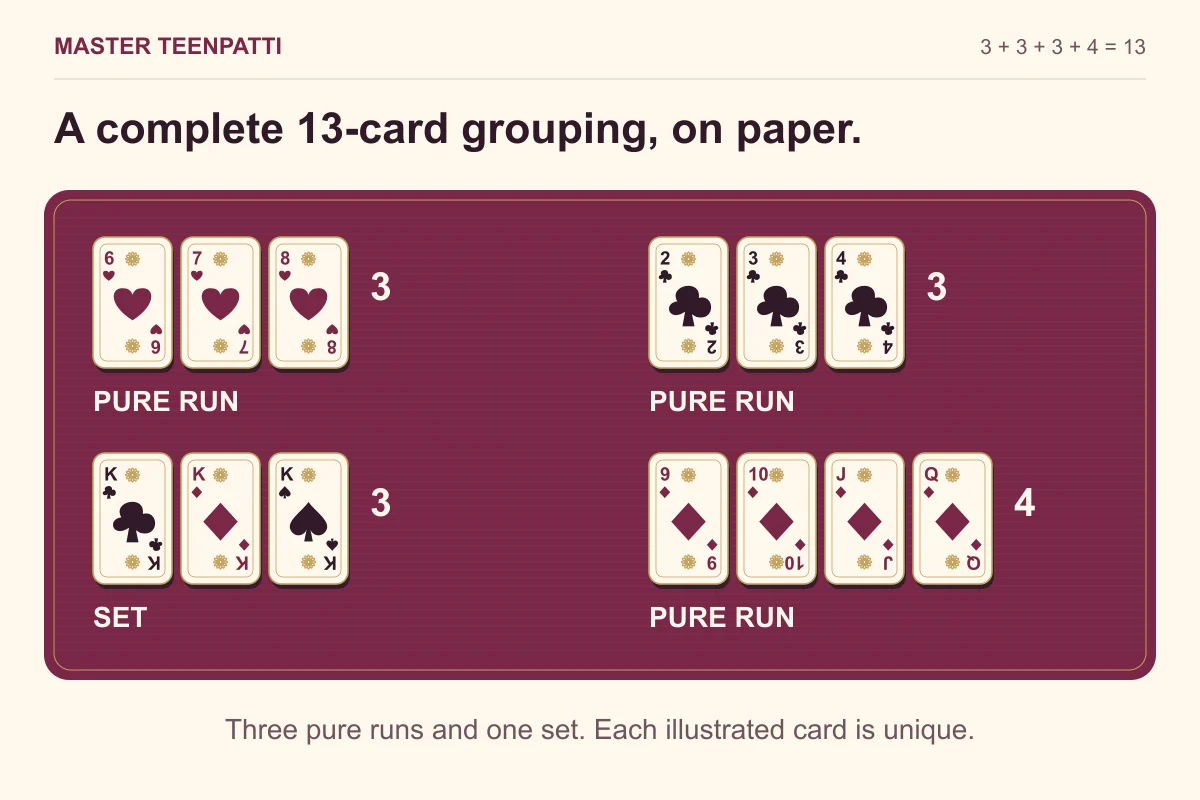
Here is a deliberately simple example with thirteen distinct physical cards and no joker: 6♥-7♥-8♥; 2♣-3♣-4♣; K♣-K♦-K♠; 9♦-10♦-J♦-Q♦. The groups contain 3 + 3 + 3 + 4 = 13 cards. Three groups are same-suit consecutive runs; the kings form a set with different suits.
Under the stated grouping requirements, this arrangement has enough sequences and contains pure sequences. It illustrates card organisation only. It does not show a completed in-app turn or every declaration rule, including what must be discarded after a draw. Read the chosen game’s actual declaration procedure before acting.
Now remove 7♥ and replace it with J♣. The first group is broken: 6♥-8♥-J♣ is neither a run nor a set. You cannot ignore those three cards because the other groups look tidy. Checking all thirteen cards is the point of the example.
Three terms that deserve a second look
A pair is a recognised Teen Patti category, but two matching ranks alone are not a standard three-card Rummy set. A trail in Teen Patti uses three cards of one rank; a Rummy set also groups equal ranks, subject to its suit and joker rules, but its value comes from fitting the full arrangement. It does not outrank a completed declaration.
A “pure” sequence in this Rummy example is formed without a joker substituting for a missing card. Teen Patti’s pure-sequence label instead tells you that consecutive cards share a suit in the classic model. Wild-card variants need their own definitions. Read the Joker and AK47 explainer before transferring rules from a special Teen Patti table.
Aces are another checkpoint. Indian Rummy can use an ace at the low or high end of a run under common rules; a wraparound K-A-2 is not a valid run in the reference used here. Teen Patti tables can differ on the relative rank of A-2-3 and A-K-Q. Familiar cards do not remove the need to read the table rules.
Choose a learning exercise, not a promised outcome
For Teen Patti practice, deal three hands of three cards and identify the winner by category and rank. Keep all nine physical cards distinct. Explain your answer aloud before checking the ranking chart. Then change a single card and ask whether the category changes. This isolates comparison errors without requiring money or an app.
For Rummy practice, lay out the thirteen-card example above, scramble it, and reconstruct its groups. Then change one card and identify which group no longer works. This isolates arrangement errors. It does not model opponents, drawing probabilities or scoring. The exercises train different tasks; neither supports a claim that one game is easier to win or more profitable.
If Teen Patti terminology is the obstacle, use the table glossary before adding variants. If you already recognise categories, the hand-probability breakdown explains how often they occur in a standard deck. Keep probability, hand strength and a game’s declaration rules as three separate questions.
There is a different selection problem in Teen Patti versus Texas Hold’em: the poker player chooses five cards from private and shared cards, rather than organising all thirteen into Rummy groups.
Questions readers ask
Is a Teen Patti trail the same as a Rummy set?
Both can contain three equal ranks, but they serve different purposes. A trail is a complete Teen Patti hand category; a Rummy set is one group within a larger valid arrangement.
Does a pure sequence win a Rummy game immediately?
No. In the 13-card rules discussed here, the whole holding must satisfy the declaration requirements. One pure sequence alone is not enough.
Can one physical card belong to two Rummy groups?
No. In the illustrated thirteen-card arrangement, each physical card is used once. Do not count the same 7♥ in both a run and a set. A multi-deck game can contain separate copies of a card, but one copy still cannot do two jobs.
Sources & scope
Teen Patti category definitions follow Octro’s learning guide. The Indian Rummy reference is Pagat’s account of the 13-card game. All card layouts and learning exercises are original examples prepared for this comparison; no app session or earnings comparison is claimed.