
You can practise Teen Patti offline with a standard 52-card deck, paper and no money. Start by identifying hands face up, then rehearse player actions. This is a tabletop exercise; it does not mean the Master TeenPatti APK has an offline mode.

Set up a short, no-cash session
Remove the printed jokers from a standard deck. Set aside a sheet of paper for the six hand categories and another for mistakes. You can practise alone by comparing three labelled hands, or take turns with friends. No phone, account, deposit or chips are needed for the first exercise.
Allow about 15 minutes: five for recognising hands, five for explaining comparisons and five for replaying a confusing example. The target is a correct explanation, not a run of wins. A lucky result says little about whether you understood the rule.
This is an 18+ learning guide. Keep the whole session free of cash, entry fees and prizes. If a practice session starts turning into pressure to bet, stop and use the responsible-play guidance.
After classifying a few deals, compare your tally with the classic hand frequencies. Small samples can vary widely. For another card-sorting exercise, try the thirteen-card Rummy layout and see why its goal differs from Teen Patti.
Exercise 1: name the category before the winner
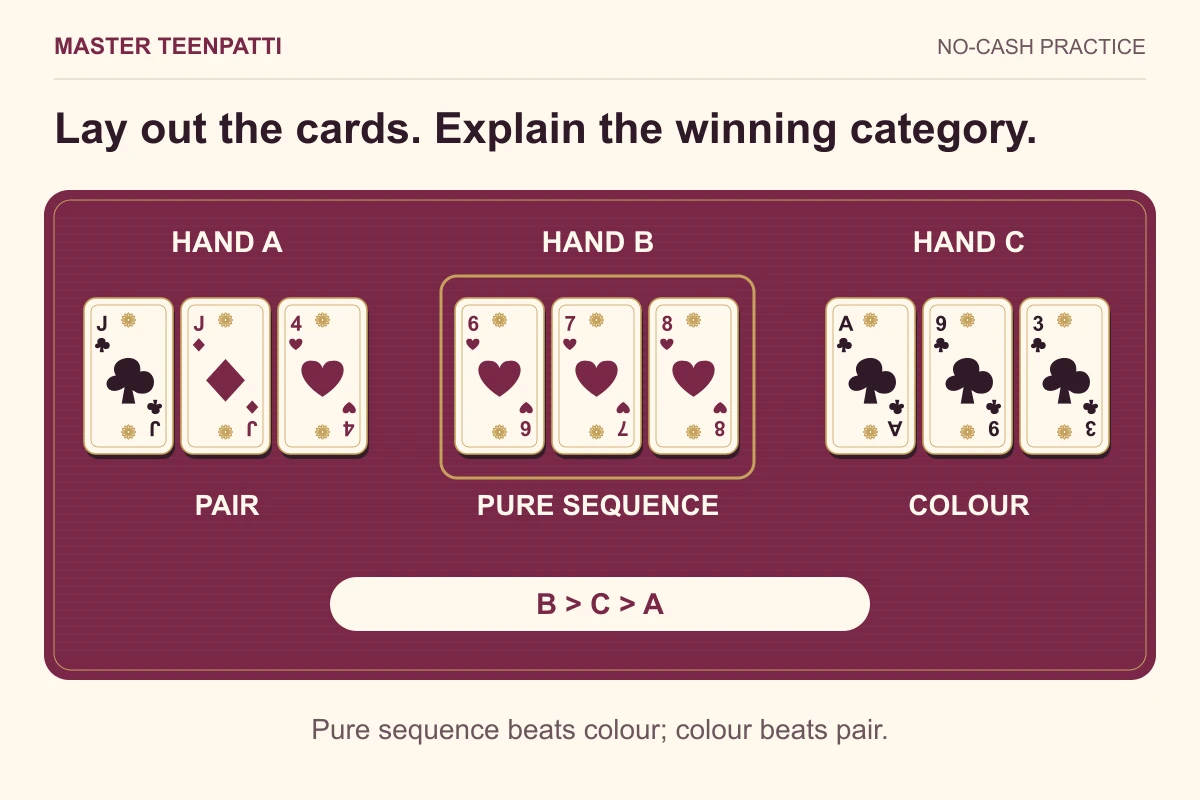
Place these three hands face up. Ask everyone to write the category before choosing a winner. All nine cards are different, so you can lay out this exact example with one deck. Use the hand-ranking chart if you need a prompt.
Hand B wins under classic rankings. Its consecutive ranks share one suit, making a pure sequence. Hand C is a colour, which ranks above Hand A’s pair. The ace in C does not outrank B’s category. Say “pure sequence beats colour” rather than “eight beats ace”. You can check this category order against Octro’s published Teen Patti rankings.
Swipe sideways to see all columns →
| Hand | Cards | Category |
|---|---|---|
| A | J♣ J♦ 4♥ | Pair |
| B | 6♥ 7♥ 8♥ | Pure sequence |
| C | A♣ 9♣ 3♣ | Colour |
Exercise 2: change one card and explain what changed
Replace B’s 8♥ with 8♦. The ranks still run 6–7–8, but the suits no longer match. B is now a sequence, not a pure sequence. It still beats C’s colour under classic rules. This is a useful test: a change in category does not always change the winner.
Next, compare A♣ J♣ 8♣ with A♦ J♦ 5♦. Both are colours. Their aces tie, their jacks tie, then eight beats five. Do not use suit colour or the order in which cards were dealt to decide this comparison. See sequence versus colour for more examples. Pagat’s Teen Patti rules also explain comparing a colour from the highest card down.
Exercise 3: rehearse actions without betting
Deal three cards face down to each practice position. A player who has not looked is blind; once they look, they are seen. Ask each person to announce their status. This exercise teaches the words, not a shortcut to winning.
Use a paper marker for whose turn it is and a second marker for who has packed. A packed hand leaves the current round. Discuss show only when two active hands remain. If rehearsing sideshow, write down the eligibility and acceptance rules first; do not treat it as an unrestricted comparison button.
- Announce blind or seen before describing an action.
- Move packed hands aside so the active-player count stays clear.
- Pause at an uncertain action and consult show and sideshow rules.
Keep a mistake log, not a winnings log
Write one sentence about each wrong answer: “I compared the ace before checking the category” is more useful than “I lost”. Replay only that comparison, then shuffle and try a fresh hand. For a simple check, identify five hands in a row and explain every category without looking at the chart.
Here is a worked mistake log for the exercises above. These are example answers and corrections, not results collected from a player or an app test. Repeat the exact cards to check the correction, then change the cards and explain the rule again.
If you use counters later to learn chaal, give them no cash value and do not exchange them for prizes. Agree the illustrative stake rules before starting; the current stake and the total pot are different numbers. Our blind and seen guide separates those ideas.
Swipe sideways to see all columns →
| Example wrong answer | What the cards show | Repeat check |
|---|---|---|
| “C wins because it has an ace.” | B has 6♥ 7♥ 8♥, a pure sequence. C’s A♣ 9♣ 3♣ is a colour; category decides first. | Swap the A, B and C labels. B’s original cards must still rank highest. |
| “Changing 8♥ to 8♦ makes C win.” | B falls from pure sequence to sequence, which still beats a colour. | Replace 8♦ with K♦ instead: B becomes high card, and C’s colour now wins. |
| “The two colours tie because both have an ace and jack.” | A♣ J♣ 8♣ beats A♦ J♦ 5♦ at the third card. | Write both hands in descending rank and underline the first unequal rank: 8 versus 5. |
What this practice can and cannot teach
A face-up exercise teaches classification, comparison and vocabulary. It cannot reproduce hidden information, an app’s controls, network behaviour or the decisions of other players. Getting a worksheet right is not evidence that you will win a real game. A short run of practice hands cannot estimate your winning rate or predict the next deal. To study how often categories occur, use the full-deck counts in the hand-probability guide; those counts are not a promise about game outcomes.
Keep classic practice separate from Joker and AK47 variations. When you change the rules, start a new page of notes. For Android file information, use the download page; this offline exercise does not require the APK.
A short self-check with answers
Use a fresh deck layout for each question. Say the category first, then explain the deciding comparison before opening the answer.
7♣ 7♦ A♥ / 8♣ 8♦ 2♥
Which pair is higher?
The pair of eights. Compare the pair rank before its spare card; the ace cannot raise a pair of sevens above eights.
K♣ Q♣ 4♣ / K♦ J♦ 9♦
What breaks the tie between these colours?
Queen beats jack after the kings tie. The third card cannot reverse a comparison already decided by the second rank.
4♥ 5♥ 6♥ → 4♥ 5♥ 6♠
What changes when the six changes suit?
Pure sequence becomes sequence. The three ranks still run consecutively, but the suits no longer match.
Questions readers ask
Can I practise Teen Patti alone?
Yes. Deal several labelled hands face up, identify each category, then compare them. Solo practice teaches rankings; it does not simulate other players’ decisions.
Do I need money or an app for this exercise?
No. Use a real deck and paper. If you add counters to rehearse stakes, keep them without cash or prize value.
Does Master TeenPatti work without internet?
An offline mode has not been verified for the linked APK. The practice described here uses physical cards and makes no claim about app connectivity.
Master TeenPatti · Practical guides
A six-question warm-up for your card session
Use our six comparisons to rehearse the order: category first, then the deciding rank. Each answer includes a one-card change you can reproduce with a physical deck. The examples are practice material, not a playable mode in the APK.
Open the hand exercises →Sources & scope
The classic hand definitions and table terms follow the cited rules. The 15-minute plan, sample deal and note-taking method are our own learning exercises, not a test of the APK.
APK file details · Editorial policy
About the author

Game Variations & Strategy Editor
Teen Patti variations, AK47, Muflis, Joker, Hukam, Potblind, rule comparisons and beginner decision-making.
Author profile and guides · Public editorial profile at Play TP Master
For sources, revisions and corrections, see our editorial policy. To flag an error, email [email protected] with this page’s URL, the passage and a supporting source.