
A joker in a Teen Patti variation is a card allowed to represent another card. In a chosen-rank version, cards of the designated rank become wild. In AK47, aces, kings, fours and sevens are wild. Classic Teen Patti does not automatically give those cards that power.
First establish whether you are playing a variation
The word “joker” does not always mean a printed joker added to the deck. Published Teen Patti variations can give ordinary cards a wild role. The same 7♦ may be an ordinary seven in one round and a substitute in another. Identify the rule before ranking the hand.
Keep the classic six-category ranking nearby: trail, pure sequence, sequence, colour, pair and high card. A wild card may help form a stronger category, but it does not by itself create a new category above trail. Variations that reverse rankings, such as Muflis, require a different comparison rule.
Chosen-rank joker: one rank becomes wild
In Octro’s published joker variation, the dealer exposes an extra card after the hands are dealt; cards of that rank act as jokers. Suppose the exposed card is 7♣. A 7♦ in your hand is then wild because its rank is seven, not because its suit is diamonds.
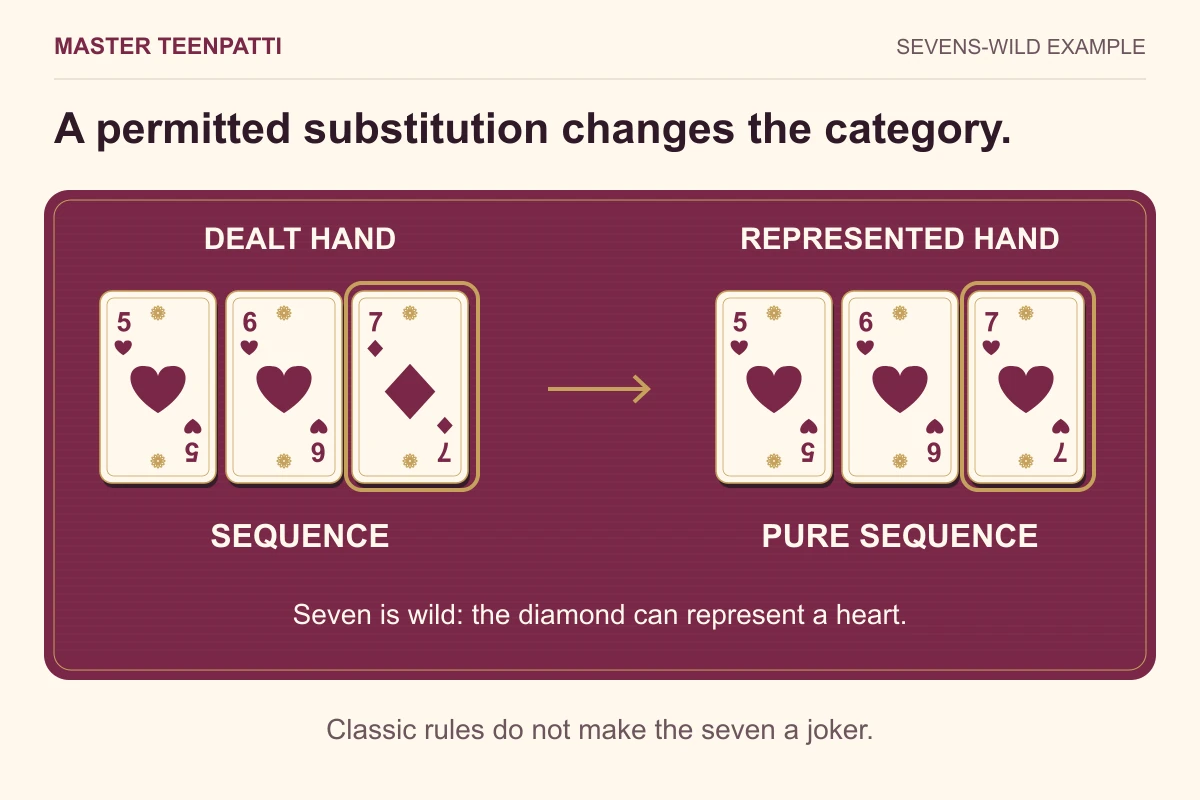
With Q♥ Q♠ 7♦, the wild card can represent another queen, forming a trail. With 5♥ 6♥ 7♦, it can represent 7♥, forming a pure sequence. These examples assume the table allows the stated substitutions. The exposed 7♣ is an indicator, not an extra card added to every player’s hand.
Swipe sideways to see all columns →
| Dealt hand | Classic reading | Joker reading |
|---|---|---|
| Q♥ Q♠ 7♦ | Pair of queens | Trail of queens |
| 5♥ 6♥ 7♦ | Sequence, mixed suits | Pure sequence in hearts |
AK47: remember four ranks, not two cards
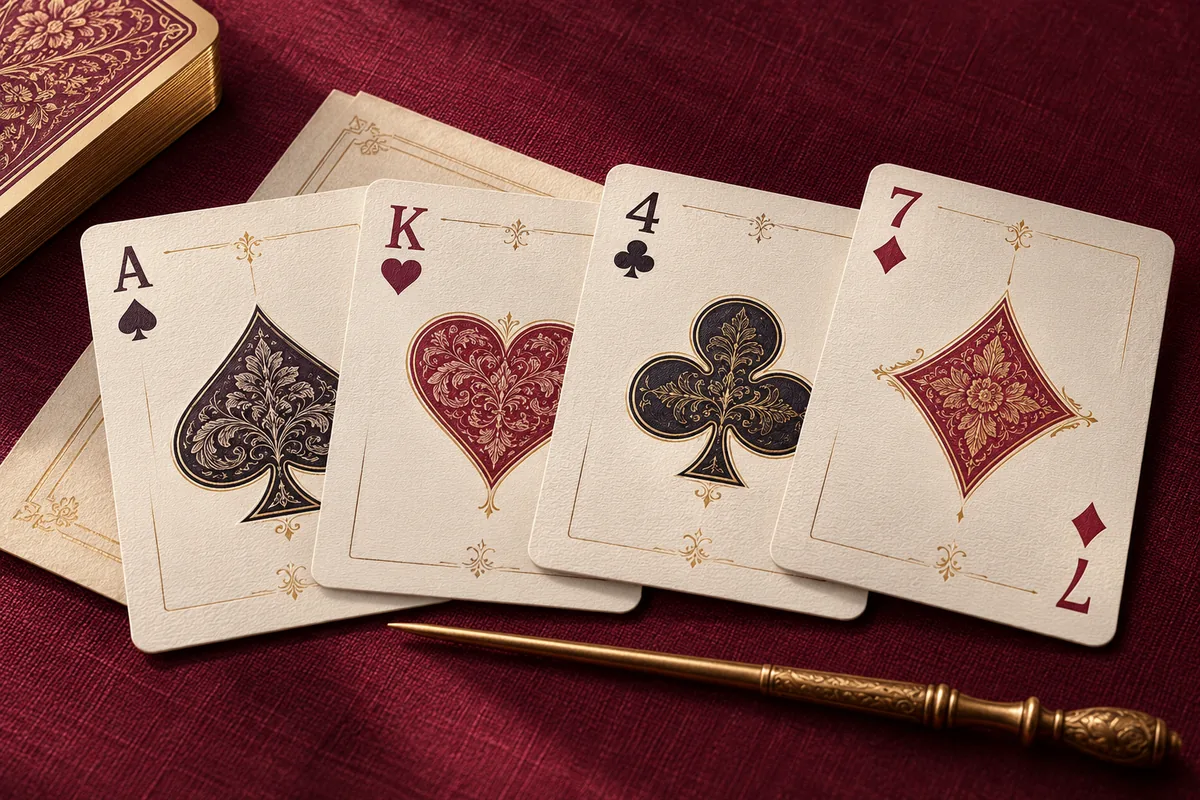
The name names the wild ranks: A, K, 4 and 7. In the published AK47 rule, all suits of those ranks are wild. A♦ and K♣ can both be jokers; a queen cannot become one just because it is a high card. Decide this before looking for a straight or a matching suit.
For example, J♥ 4♦ 7♠ contains two wild cards. They can stand for two other jacks, giving a trail of jacks. Under the classic rules the same hand is merely high card. State the represented hand when practising so everyone can see why the category changed.
A hand with several wild cards may admit more than one interpretation. Follow the selected table’s rule for the strongest permitted assignment, and its policy for identical resulting hands. Do not invent a suit tiebreak or assume that a natural hand always beats one made with jokers.
Compare the completed hand in a fixed order
First identify which dealt cards are wild. Then choose a legal interpretation. Only then compare categories and ranks. Comparing the printed values first is the usual source of confusion: the purpose of a wild card is precisely to change what the hand can represent.
As a non-tied example with sevens wild, Q♥ Q♠ 7♦ makes queens, while J♣ J♦ 7♥ makes jacks. Both are trails, so the queens win under the usual rank order. The result comes from comparing the completed trails, not from comparing the two sevens.
- Read the variant name and designated wild rank.
- Explain the substituted card and resulting category.
- Compare ranks within that category; use the table’s published procedure for a tie.
Five details to settle before the first deal
“Joker rules” alone is not a complete agreement. A chosen-rank joker, a lowest-card joker and AK47 select wild cards differently. Mixing those instructions can turn the same deal into different results. Record one rule set and keep it for the whole practice round.
Swipe sideways to see all columns →
| Detail | Question to answer |
|---|---|
| Wild selection | Which ranks are wild, and when are they selected? |
| Substitution | Which card values and suits may a joker represent? |
| Ace runs | How are A–2–3 and A–K–Q ordered? |
| Ties | How are equal completed hands resolved? |
| Player actions | Do blind, seen, show and sideshow rules change? |
Practise the change without assuming app support
Start with the two hands in the table above. Read each once under classic rules and once with sevens wild. Write the two category names before choosing any winner. If the reason is still unclear, revisit sequence versus colour.
These are general card-game variations, not a verified feature list for the linked Master TeenPatti APK. For a no-cash learning session use our offline practice plan; for terms used during play, use the Teen Patti glossary.
Questions readers ask
Are printed jokers required for AK47?
Not in the AK47 rule described here. Ordinary aces, kings, fours and sevens take the wild role. Check the selected table before adding any extra cards.
Is a seven always a joker in Teen Patti?
No. It is an ordinary seven in classic Teen Patti. It is wild in AK47 or when a particular variation designates it as wild.
Does a natural trail always beat a joker-made trail?
There is no single tie rule to assume across every table. Compare the represented ranks and read the table’s rule for equal hands and natural-versus-wild priority.
Sources & scope
Joker selection and AK47 ranks are based on Octro’s published variation rules. The deals and comparison walkthroughs are original examples. They do not verify these modes in the linked APK.