
In reversed-ranking Muflis, the hand that would lose a normal Teen Patti comparison wins instead. A mixed-suit high-card hand can beat a pair. Keep the categories intact: “low hand wins” does not automatically mean “add the three card values” or “the smallest individual card wins.”
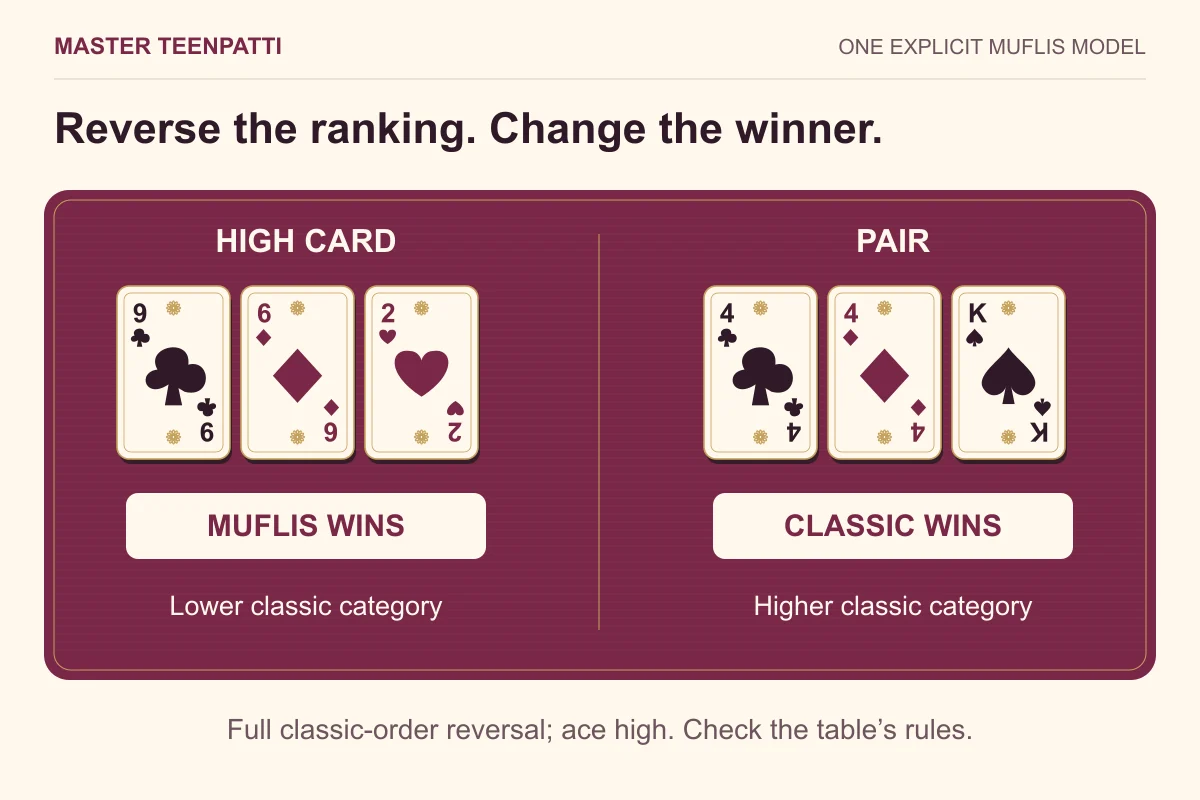
Which Muflis rules are used here?
For the examples on this page, reverse the complete classic Teen Patti comparison. Keep trail, pure sequence, sequence, colour, pair and high card as separate categories. Treat an ace as high in an ordinary high-card hand. Use the agreed classic sequence order before reversing a comparison between sequences. There are no jokers in these examples.
Octro describes Muflis as the ordinary game with the weaker hand winning. That is the model used here. Other low-hand tables may specify different ace or combination treatment. Read that rule before using an example from this page. In particular, do not combine an ace-low rule from one table with a full category reversal from another and assume the result is universal.
If the normal categories are unfamiliar, take a moment with the classic hand-ranking chart. Muflis is easier to follow when you can first explain which hand would win the ordinary comparison.
The six categories in reverse
Read this table from top to bottom as the order preferred in the stated Muflis model. “High card” means the hand has no pair, sequence or colour; it does not mean that an especially high individual card is desirable.
Swipe sideways to see all columns →
| Muflis order | Category | Check before comparing ranks |
|---|---|---|
| 1 | High card | No pair, no sequence and mixed suits |
| 2 | Pair | Two equal ranks |
| 3 | Colour | One suit, not consecutive |
| 4 | Sequence | Consecutive ranks, mixed suits |
| 5 | Pure sequence | Consecutive ranks, one suit |
| 6 | Trail | Three equal ranks |
Example one: the king does not decide it
Compare A: 9♣ 6♦ 2♥ with B: 4♣ 4♦ K♠. Hand A has no repeated rank, no run and mixed suits, so it is high card. Hand B is a pair of fours. In classic Teen Patti the pair beats high card. Reverse that result for this Muflis example: A wins.
The king in B is a distraction at this stage. Replacing it with 7♠ leaves B as a pair, so A still wins the category comparison. This is a useful paper exercise because it catches the habit of looking for the lowest or highest single card before identifying the complete hand. No amount needs to be placed on either hand to practise the rule.
Example two: compare the second card
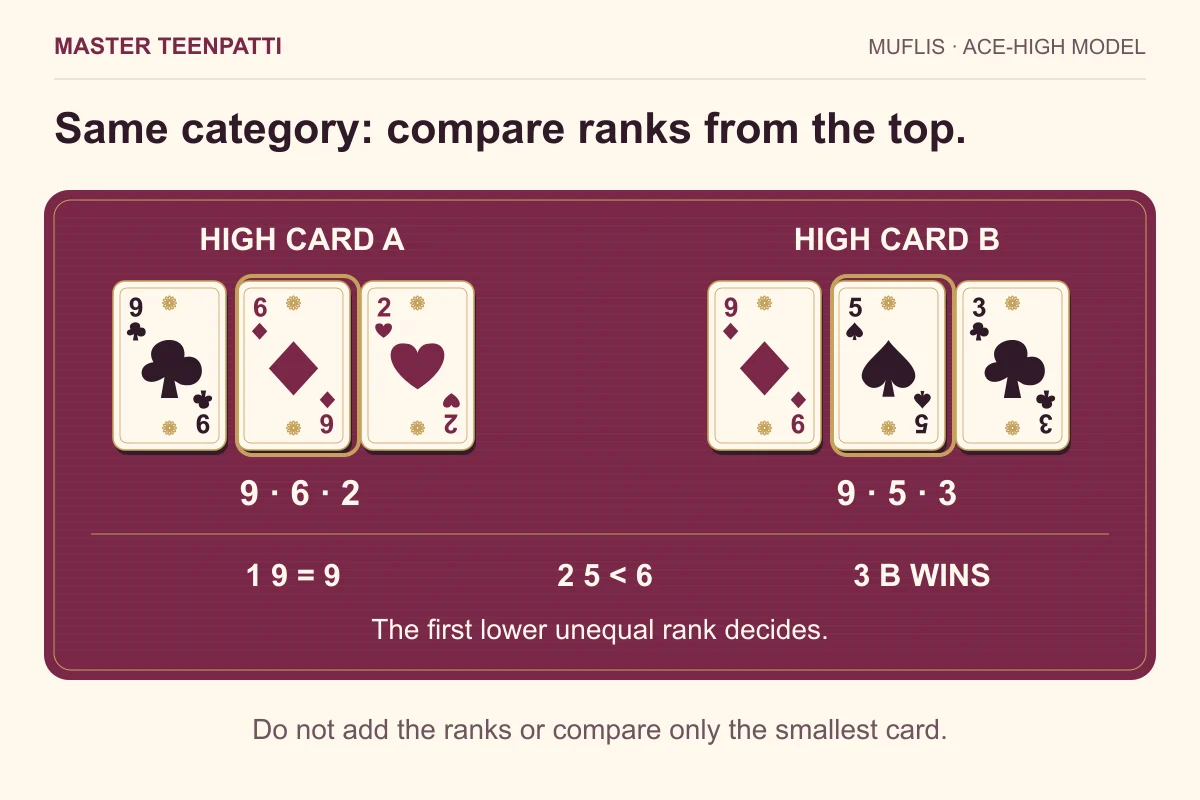
Now compare A: 9♣ 6♦ 2♥ with B: 9♦ 5♠ 3♣. Both are high-card hands. Sort each by rank, highest first. The nines tie. At the second position, six is higher than five, so A would win the classic comparison. Under this Muflis model, B wins instead. There is no need to compare the remaining two and three.
Notice that both hands total seventeen if you assign ordinary numerical values. Adding the cards would call them equal and miss the result. Muflis is not a lowest-total contest under the rules used here. Write the comparison as three columns—top, middle, bottom—and stop at the first difference.
For a practice check, keep the nines and replace B’s five with 7♠. A now wins Muflis because its second card, six, is lower than seven. Only one card changed, and the decision changed at a clearly identifiable position.
Example three: a low-looking run is still a run
Compare A: 3♣ 4♦ 5♥ with B: 8♣ 6♥ 2♠. A is a mixed-suit sequence; B is high card. Under normal Teen Patti categories the sequence wins. Reverse that comparison and B wins Muflis, even though A’s individual card values look smaller. Treating A as “three low cards” would erase the sequence category.
Suits can create the same trap. Change B to 8♣ 6♣ 2♣ and it becomes a colour. Against a mixed-suit high-card hand, that colour loses under the stated reversed ranking. The sequence and colour examples help you identify the category before deciding which direction the ranking goes.
This also explains why “A-2-3 is always best in Muflis” is not a reliable rule. A table that retains sequences still recognises A-2-3 as a sequence. A different lowball convention may evaluate it differently. State the convention first; then compare the cards.
An equal comparison still needs a table rule
Two hands can have identical rank patterns in different suits. With no suit hierarchy, neither is lower. Reversing a comparison does not magically break that tie. Check the rule for the actual action: a requested show, an accepted sideshow and an automatic comparison may have different procedures.
These diagrams compare exposed hands on paper; they are not a three-player show procedure. Learn show versus sideshow separately. A variant that changes the winning hand does not automatically change how many players must remain, who may request a comparison or whether a request can be refused.
A four-question check before naming the winner
Keep a short rule card beside the deck. Write the ace rule and whether combinations still count. Then compare a pair of hands using the questions below. Say the classic result first and the Muflis result second; the contrast makes an accidental switch back to ordinary rankings easier to spot.
- What category is each complete hand?
- If the categories match, where does the ordinary rank comparison first differ?
- Which hand loses that ordinary comparison?
- If neither is lower, what exact tie procedure has been agreed?
Move to another variation only after the rule is clear
A useful next exercise is to alternate a clearly labelled Classic card and Muflis card between deals. Keep the dealt hands unchanged and explain why the preferred hand changes. The offline practice guide provides a way to record mistakes without stakes.
Joker and AK47 introduce substitutions rather than simply reversing the comparison. Use the wild-card guide for those rules. The classic probability table counts categories; reversing their preference does not change how many such hands exist in the same deck. It also does not make a future result predictable.
Questions readers ask
Does the smallest individual card win Muflis?
Not in the model on this page. First identify both categories; if they match, reverse the normal rank comparison. A low individual card does not cancel a pair or sequence.
Does a trail beat high card in Muflis?
Under full reversed classic rankings, high card is preferred to trail. The trail would win in classic Teen Patti, so it loses this reversed comparison.
Can I decide a Muflis comparison by adding the cards?
Not in the full reversed-ranking model. In the worked example, 9-6-2 and 9-5-3 have the same total, but 9-5-3 wins because its second card is lower after the nines tie.
Sources & scope
The basic Muflis rule is referenced to Octro’s variations page, with classic categories from its learning guide. The rank-column method, card layouts and exercises are original worked applications. Examples describe the stated model, not every local lowball convention.